
Making It Bankable
The missing layer in America's robotics conversation

This is a dispatch of The Body Problem — my thoughts on robotics and the future of governance. If you read the fifth essay, "Scarcity Was the Operating System," you encountered the argument that the United States needs more automation, not less, but the institutional architecture to act on it does not exist. This dispatch is the operational question that argument left unanswered: if everyone agrees America needs more robots on factory floors, why has nobody built a coherent way to finance putting them there?
Washington has spent the past year calling for a national robotics strategy. Everyone agrees the United States needs a plan. Some of the proposals on the table are serious, and are worth doing — more R&D coordination, stronger supply chains, defense-industrial-base modernization, workforce pipelines. But they share a common blind spot. They are organized around invention, procurement, and security — the top of the funnel — while a key binding constraint for most of the American industrial base is at the bottom. Not whether the robot exists. Whether the deployment pencils out.
A fifty-person contract manufacturer in Dayton is not wondering whether robots work. She is trying to answer a narrower question: how do I pay for this?
The United States needs more automation, not less — the country lags its competitors in robot density, productivity growth has stalled, and manufacturers suffer from too little investment in the machines that would make their workers more productive. The question is why a country that broadly agrees it needs more robots has built no coherent way to finance putting them on factory floors.
In the 2022 Economic Census — the most comprehensive federal count — 6.4 percent of U.S. manufacturing plants reported having robots. About 98 percent of manufacturing establishments have fewer than 500 employees. In the most detailed public survey of small and mid-sized manufacturers’ robotics engagement, conducted by the ARM Institute and four MEP centers, 55 percent of respondents cited upfront cost as the leading barrier to technology adoption. Manufacturers know robots exist. They cannot make the math work.
The cost barrier runs deeper than the sticker price. In many common use cases, a collaborative robot arm costs less than a year of the labor it augments. The cost that kills deployment is everything around the arm: integration, commissioning, software, training, infrastructure modification, production disruption, and the liability envelope that attaches to a system whose behavior may change with software updates. The best public source on this ratio — a 2021 NIST report on cobot integration in small manufacturing operations — says that experienced integrators advise SMMs to budget around three times the price of the cobot system to cover full integration costs, while some MEP centers have observed ratios as low as half to one times the cobot cost in simpler deployments. That is a range, not a fixed number. But even the low end means the integration bill rivals or exceeds the hardware purchase.
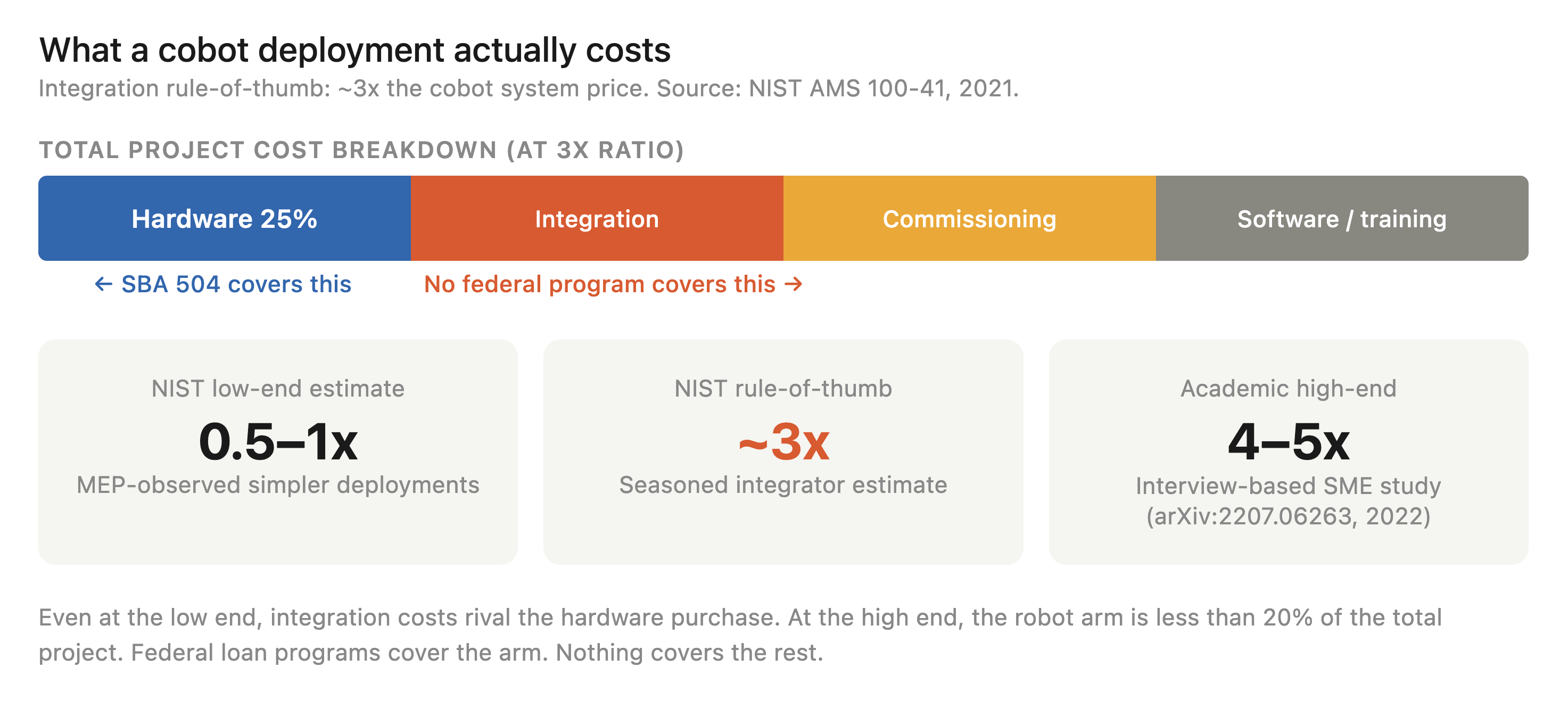
For a firm with fifty employees and thin margins, that math shows up as a risky capital expenditure with uncertain payback, unclear residual value, and no mature way to convert it to an operating expense. The CFO’s rational calculation is: wait.
Two different markets, one blurred conversation
Part of the confusion is that the policy conversation keeps collapsing two different markets into one.
The first is firms that want to automate but cannot close the financing. They have identified the use case, maybe spoken to an integrator. They are blocked because the project is too bespoke to underwrite, the integration risk is too uncertain to insure, and the available credit channels were not designed for this kind of purchase. The second is firms that do not yet see a reason to automate. These firms need proof — business-case evidence, demonstrations, trusted local institutions that can help them evaluate whether automation fits their operation. Their barrier is information and confidence, not capital.
The distinction matters because most of the policy ideas currently circulating help one market but not the other.
Bonus depreciation is back at 100 percent, and that is real and welcome. But it helps firms that already have taxable income and already intend to buy. It does not solve the integration-risk problem, the insurance gap, or the lender hesitation that blocks the first market. It does not reach the second market at all.
R&D funding matters for the frontier but is downstream from adoption. Federal procurement helps some sectors but not most small manufacturers. Supply-chain investment addresses a real vulnerability but does not put a single robot on a single factory floor in Ohio.
The missing layer is deployment finance.
What solar can teach robotics
The closest analogy is what happened to solar energy after the United States figured out how to make it financeable.
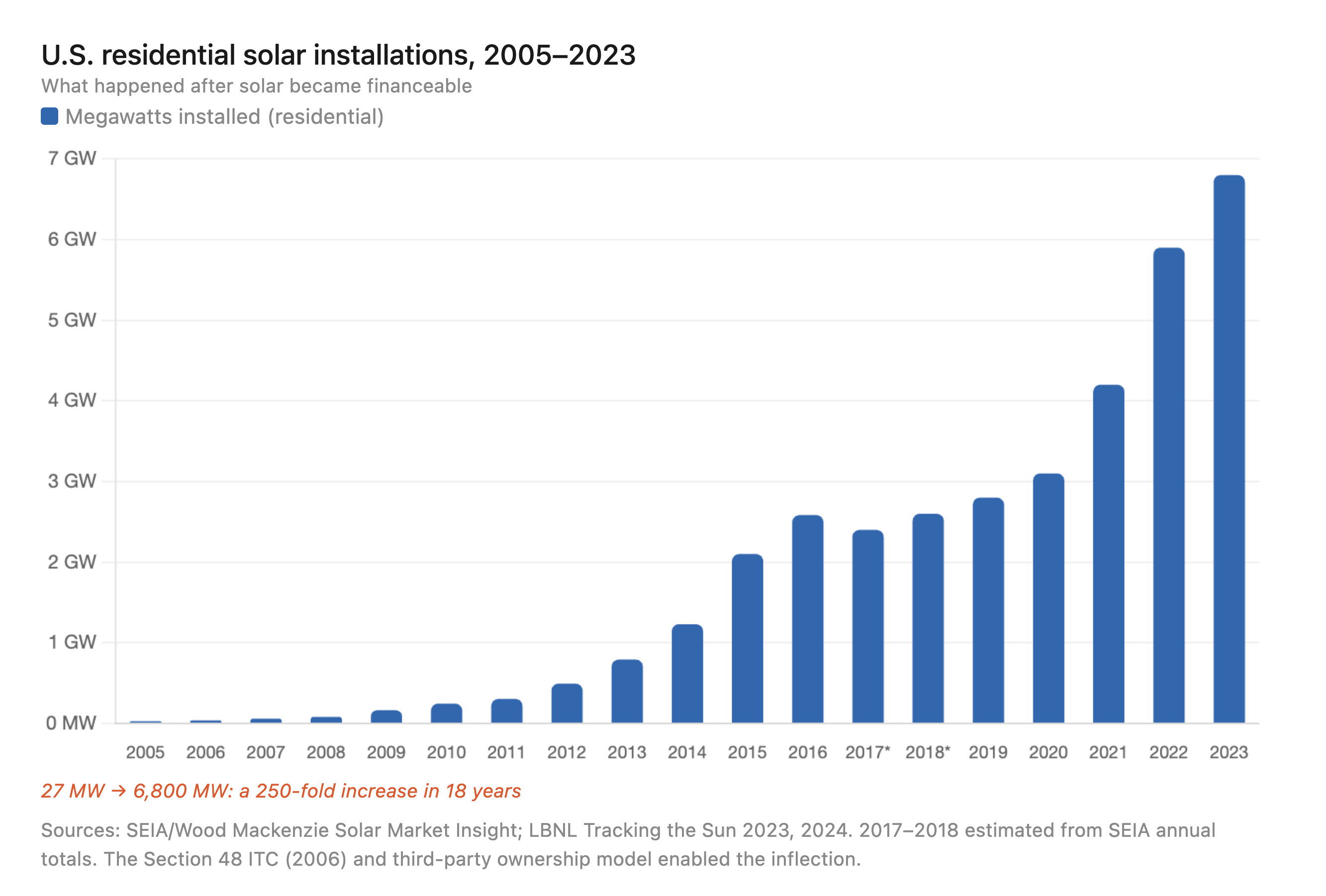
In the mid-2000s, rooftop solar faced a problem structurally similar to robotics today: the technology worked, but the deployment model was broken. Residential and commercial customers faced high upfront costs, complex installation, and uncertain returns. Adoption was negligible — 27 megawatts of residential solar installed in 2005, according to SEIA.
What changed was not primarily the technology. It was the financing model. The Section 48 investment tax credit, combined with five-year accelerated depreciation, created the economic foundation for third-party ownership. Developers could own the panels, monetize the tax benefits, and sell the power to the building owner through a power purchase agreement or lease. The customer’s upfront cost dropped to zero. Solar deployment became an operating expense, not a capital expenditure.
Residential solar installations grew from 27 megawatts in 2005 to 6.8 gigawatts in 2023 — a 250-fold increase. Third-party ownership’s share of residential installations peaked at roughly 60 percent in 2012 before direct purchase gained share as system costs fell and solar loans matured. The ITC mattered less as a subsidy than as a structural enabler — it made solar deployment a repeatable financial transaction instead of a one-off capital project.
Robotics is still in the pre-PPA era. The hardware exists. Nobody has built the financing architecture around it.
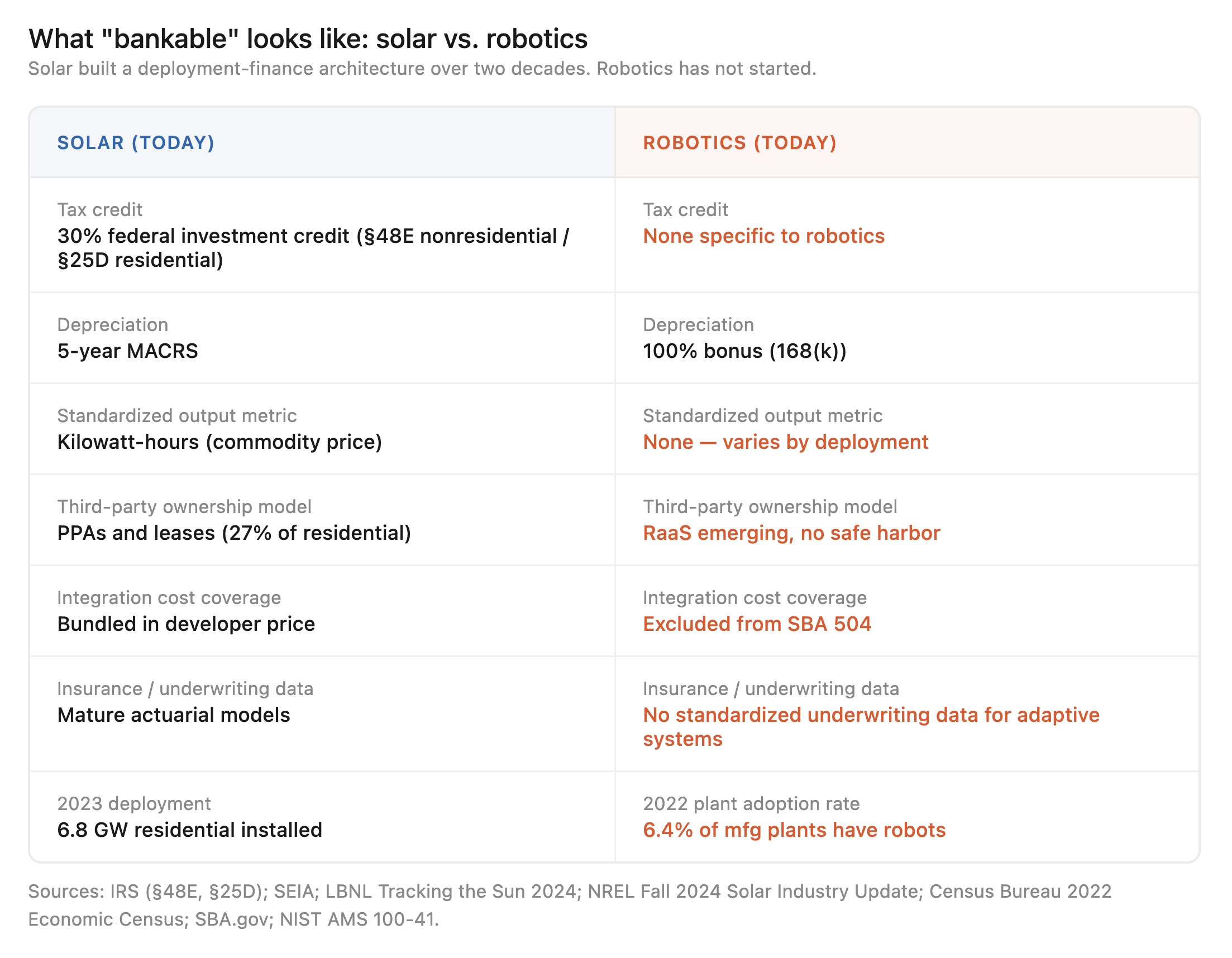
The analogy is imperfect, and it matters where. Solar produces a commodity — kilowatt-hours — with a known market price. That made it possible to write a power purchase agreement: the developer knows what the output is worth before the panels go up. A robot produces productivity gains that vary by deployment, by task, by facility. There is no standardized unit of output to price a contract against. This means the robotics version of the PPA will need to be built on performance metrics — uptime, throughput, cycle time — rather than a commodity price. That is harder to standardize, harder to underwrite, and harder to scale — and the difficulty may be structural, not transitional.
A CNC loading cell and a palletizing cell have different KPIs. The variance across applications is the point, not noise. Nobody has yet demonstrated that robot deployment performance can be standardized enough across use cases to securitize. Formic’s per-hour pricing works for repetitive, well-defined tasks; it is not clear it extends to the heterogeneous deployments that make up most of the SMM market. This is the hardest unsolved problem in the deployment-finance thesis, and the NIST underwriting-data recommendation exists precisely because the problem has not been solved. Someone has to build the measurement infrastructure that makes robot deployments comparable the way SEIA and NREL made solar projects comparable. Until that exists, the financing architecture cannot mature.
But the analogy also understates the urgency. Being five years behind on solar deployment did not have compounding consequences, because solar panels do not improve through use the way robots do. Every deployment generates task data — every grasp, every collision, every correction — that feeds the models governing the next deployment. As I have argued elsewhere, the country that deploys across the most diverse environments accumulates a data advantage that a later entrant cannot close by building a better algorithm. The financing problem is an adoption problem and a technology problem at the same time — the United States cannot remain competitive in the underlying technology without generating the deployment data that only comes from putting robots on factory floors.
The robotics-as-a-service model: promising, not proven
The private sector is trying to solve the capex problem directly. A small but growing number of companies now offer robots on per-hour or per-unit pricing models with no upfront capital requirement — the solar PPA model applied to a robot cell. The most visible of these, Formic, reports over 500,000 robot usage hours, a fivefold increase in deployments in 2025, a 97 percent renewal rate, and 99.3 percent uptime. Those are self-reported metrics, not independently audited — but the $27.4 million Series A extension that followed suggests investors found them credible.
The broader market, however, has struggled to scale. Of the five companies most commonly cited as robotics-as-a-service pioneers for manufacturing, three exited in under two years: READY Robotics shut down in August 2024 after a funding round collapsed, Veo Robotics was acquired by Symbotic for $8.7 million in July 2024, and Rapid Robotics’ assets were acquired by RobCo in September 2025. That pattern suggests something more than execution failure — the commercial infrastructure to support the model at scale does not yet exist. Even the leading providers still appear to be measured in the hundreds of active deployments, not thousands.
The model works where it works — standardized tasks, predictable environments, manufacturers ready to adopt. But it has not yet reached the kind of repeatable, financeable scale that solar achieved after the ITC enabled third-party ownership. The question is whether the market can build that scale on its own, or whether it needs the same kind of public-finance architecture that solar required.
The federal tools that already exist
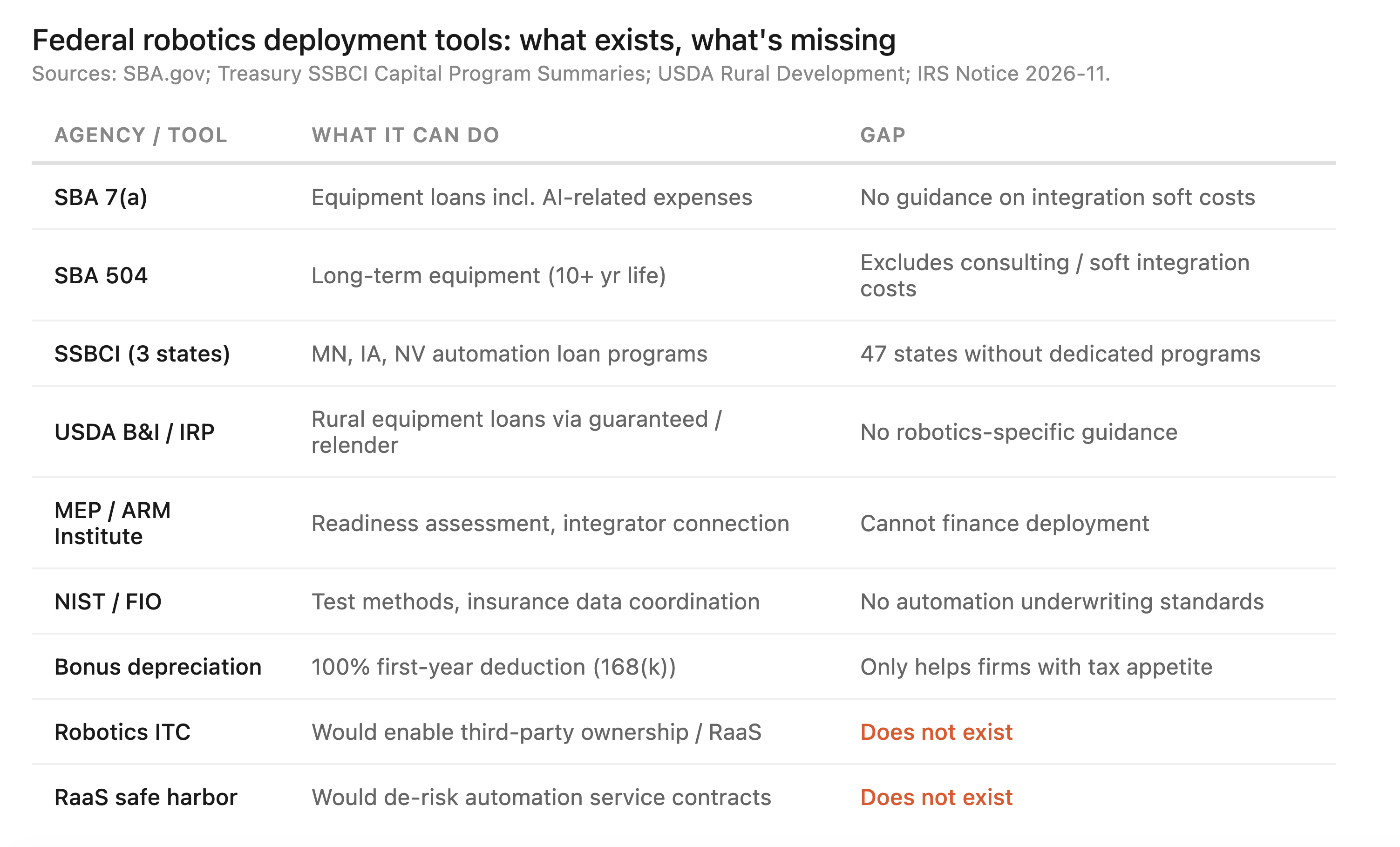
The executive branch already has tools that could matter. They are scattered across agencies, designed for other purposes, and largely unknown to the manufacturers who need them. Nobody has assembled them into a coherent stack.
SBA 7(a) and 504 loans. Both programs list “purchasing and installation of machinery and equipment” as eligible uses, and the SBA now explicitly includes AI-related expenses. SBA 504 can finance long-term equipment with a remaining useful life of at least ten years. Industrial robots qualify. Under current rules, what it cannot finance is AI-related consulting services or soft integration costs — the very costs that, per the NIST data, may equal or exceed the hardware price. That gap matters — the costs the programs exclude are the costs that actually determine whether the project happens.
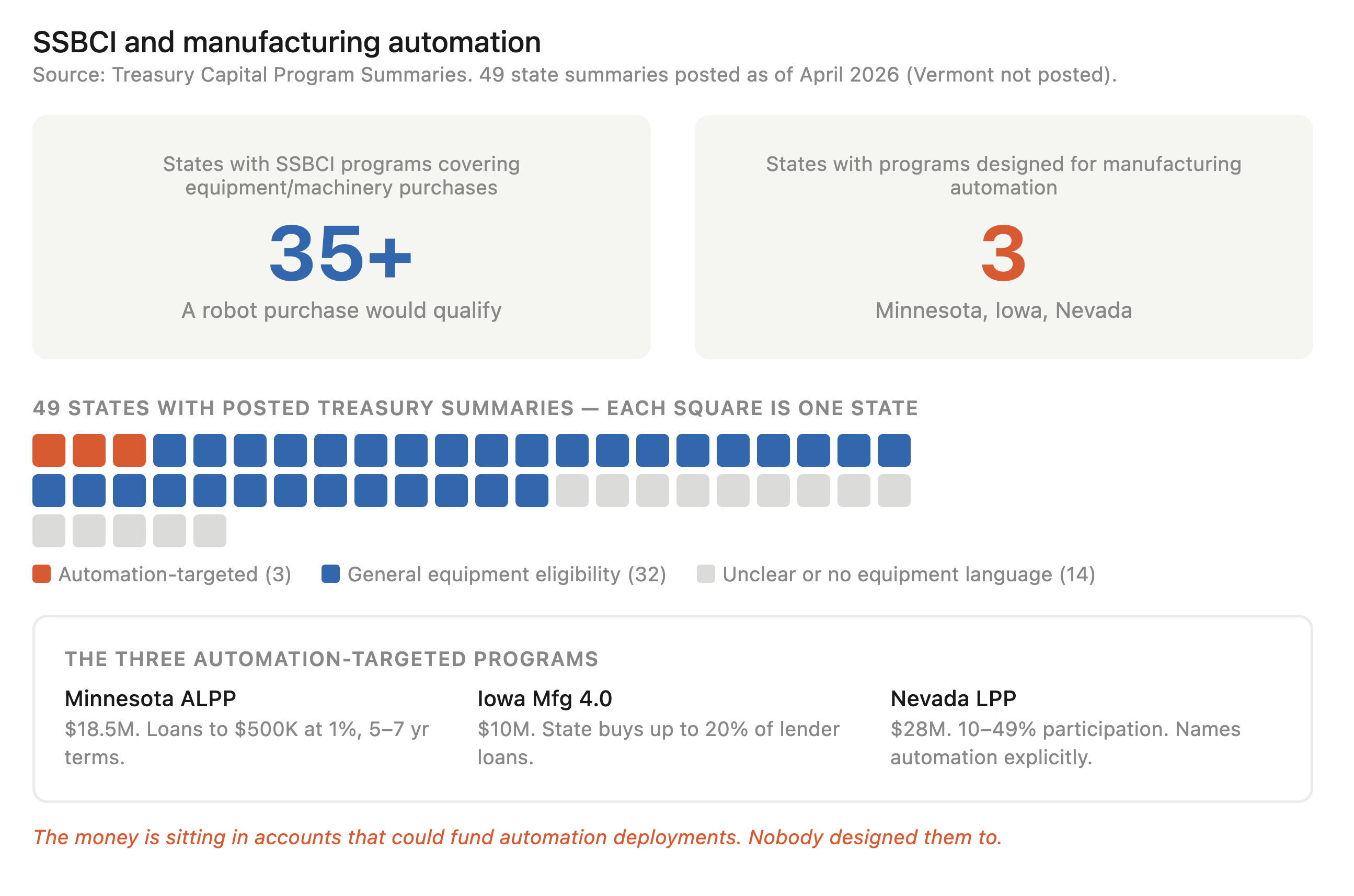
State SSBCI programs. The Treasury Department’s State Small Business Credit Initiative is in every state, and at least 35 have programs whose Treasury-published eligibility language clearly covers equipment or machinery purchases (based on a review of all 49 posted state summaries on Treasury’s Capital Program Summaries page as of April 2026) — meaning a robot or cobot purchase would qualify. The money is there. The problem is targeting. Only three states — Minnesota, Iowa, and Nevada — have designed programs explicitly around manufacturing automation. Minnesota’s Automation Loan Participation Program offers companion loans up to $500,000 at 1 percent interest over five to seven years. Iowa’s Manufacturing 4.0 program purchases up to 20 percent of approved lender loans. Nevada’s program explicitly covers automation equipment, software, and workforce training. The remaining 32-plus states can technically finance robot purchases through general equipment programs, but nobody has told the manufacturers — or the lenders — that this is what the programs are for. The money is sitting in accounts that could fund automation deployments. Nobody designed them to.
USDA rural lending. The Business & Industry guaranteed loan program covers “purchase and installation of machinery and equipment,” including in rural manufacturing. The Intermediary Relending Program can finance equipment through local relenders. Neither is designed for robotics, but both are technically eligible. REAP — the Rural Energy for America Program — is narrower: it covers renewable energy and energy efficiency, not general automation, unless the project can be framed as a qualifying energy-efficiency improvement.
MEP and Manufacturing USA. The MEP network has 51 centers reaching manufacturers in every state. Some, like Wisconsin’s WMEP, have built explicit automation advisory capacity. The ARM Institute, the Manufacturing USA hub for robotics, has a new five-year cooperative agreement at $87.66 million. These institutions can assess readiness, connect firms to integrators, and reduce the information barrier. What they cannot do is finance the deployment.
What is missing
The pieces are scattered across half a dozen agencies. Nobody has assembled them.
In theory, a small manufacturer can get an SBA 504 loan for a robot arm, a state SSBCI participation for part of the financing, a readiness assessment from her MEP center, safety guidance from OSHA’s consultation program, and 100 percent bonus depreciation on the purchase. In practice, her lender has never underwritten a robot cell, her insurer has no actuarial model for adaptive automation, and the integration cost — the three-times multiplier — falls into a gap between the equipment loan and the consulting expense that no single program covers.
Five things would close the gap, and most of them require guidance, not legislation.
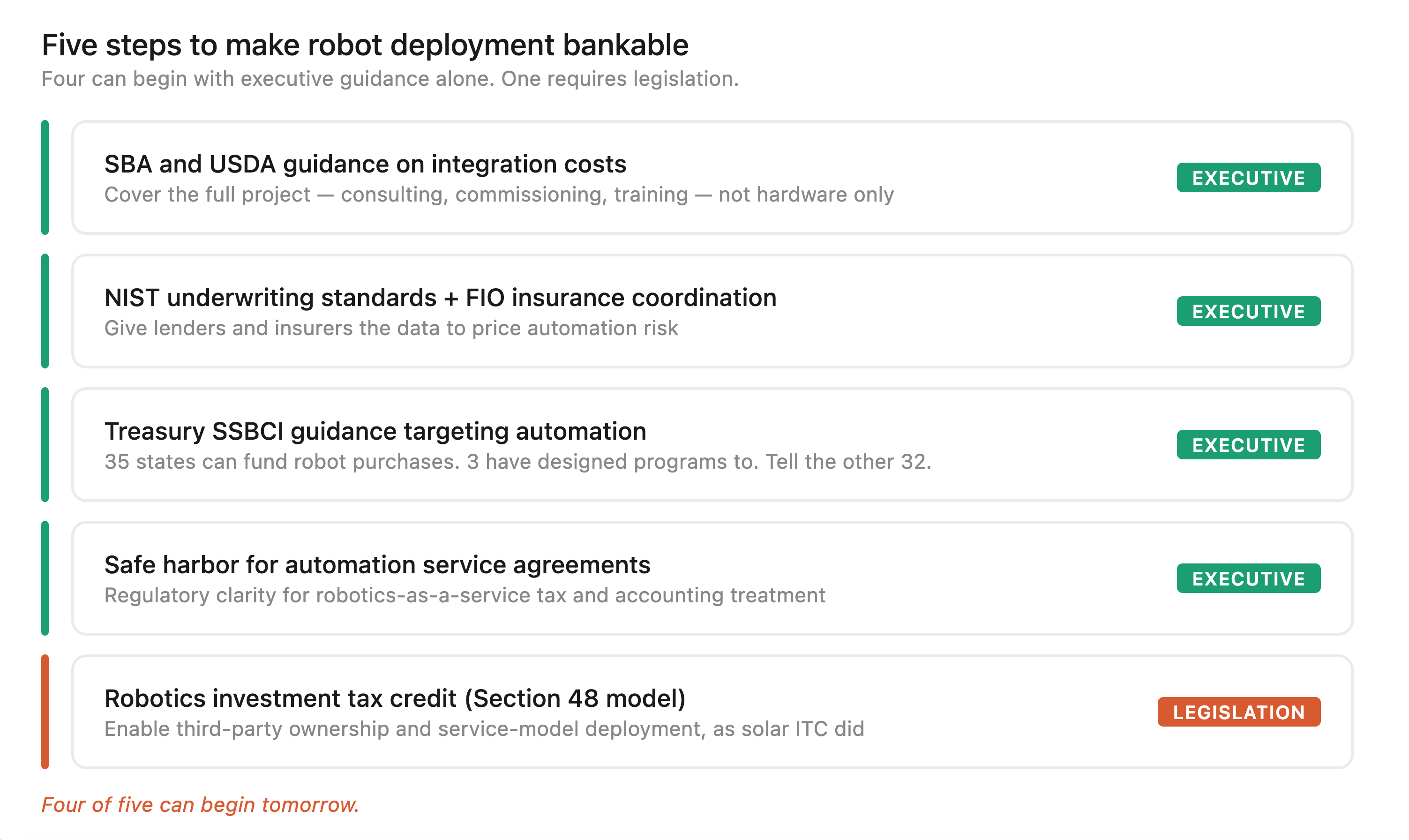
None of these require new legislation except the ITC. The SBA guidance, USDA clarification, NIST standards work, Treasury/FIO insurance coordination, and SSBCI expansion are all within existing executive authority. They could begin tomorrow.
The frame that matters
The conversation about a national robotics strategy is welcome. The United States should have one. But any strategy that does not address deployment finance is missing the bottleneck. Most American manufacturers are stuck on a question about money: how do you finance a robot deployment when the integration cost is three times the hardware, the insurance market has no standardized underwriting data for adaptive automation, and the loan programs that could help have never been pointed at this use?
China’s approach to deployment finance is direct subsidies, provincial incentives, and state-coordinated data sharing — and the scale is not abstract. Beyond the NDRC’s $138 billion national fund, municipal governments have created their own: Shenzhen launched a $1.4 billion AI and robotics fund in early 2025, Hangzhou has committed roughly $14 billion in industrial funds to AI, and Shanghai and Beijing operate their own subsidy programs covering both R&D and factory-floor deployment.
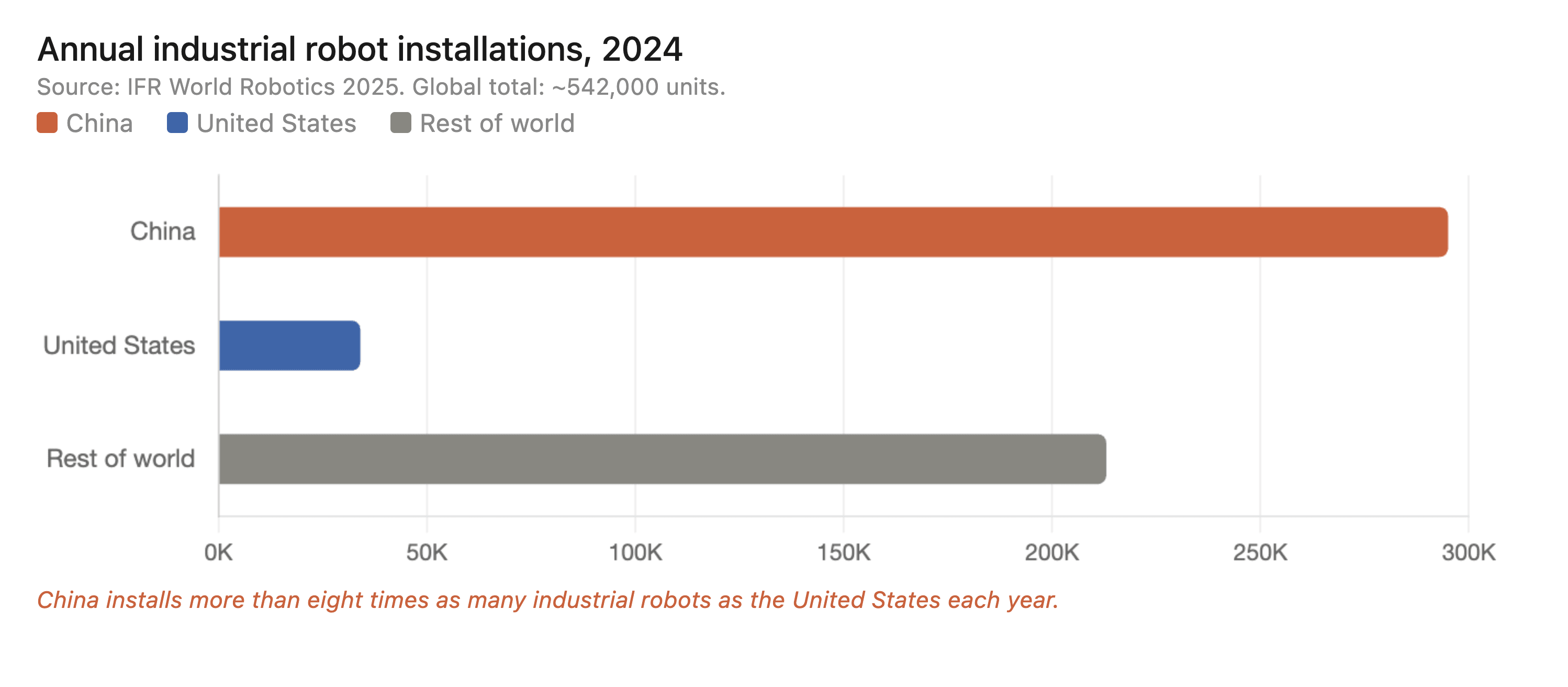
But part of the reason Chinese automation is cheaper is structural — a country that installs roughly eight times as many robots each year spreads engineering and tooling costs, builds denser supply chains, and lets manufacturers design for volume rather than bespoke projects. The deployment-finance problem and the cost problem are the same problem: scale the market and the costs come down. Once financing unlocked scale, deployment surged and system costs fell sharply — residential solar prices dropped more than 60 percent from 2010 to 2020. The same dynamic is available to robotics — but only if deployment scales first.
The United States does not need to replicate that model — and could not if it tried. But it needs an answer. Right now it does not have one.
The tools exist. Thirty-five states have SSBCI programs that cover equipment purchases. SBA and USDA loan programs cover machinery. Bonus depreciation is at 100 percent. MEP centers are in every state. None of these have been assembled into a deployment-finance architecture, and none address the integration costs that are the actual barrier.
The country that figures out how to make robot deployment bankable for its small manufacturers is the country that will lead in robotics. Not because it invented the best robot. Because it built the commercial architecture that put robots on factory floors at scale.
America already knows how to do this. It did it with solar. It has not yet done it with robots.
Move robotics policy from invention to deployment finance. Make it bankable.