
Sinew
On machine tools, harmonic drives, SEC filings, and why the real dependency isn't where Washington thinks it is

This is the first dispatch of The Body Problem — my thoughts on robotics and the future of governance. If you read the second essay, "Intelligence Wants a Body," you encountered the claim that the supply chain for embodied AI is structurally different from semiconductors. This dispatch is the homework behind that claim — and, in places, a complication of it.
On September 2, 2025, the Bureau of Industry and Security opened a Section 232 investigation into whether imports of industrial machinery — CNC machines, grinding equipment, robots, stamping and pressing systems, tool changers — pose a threat to national security. The investigation drew 277 public comments. The statutory deadline for the Secretary’s report to the President is May 30, 2026.1
The investigation rests on a premise that has become conventional wisdom in Washington: the United States depends on foreign suppliers for the physical components of its emerging robotics industry the same way it depends on Taiwan for advanced semiconductors. The policy conclusion follows naturally. If this is a chip problem, use chip instruments. Tariffs. Export controls. Friend-shoring. Section 232.
I spent the last month in the trade data. The semiconductor analogy gets the topology of this problem wrong — but not in the direction most people expect.
The market BIS is actually investigating
U.S. machine tool production was $7.1 billion in 2024 — fourth globally in absolute terms. That sounds reassuring until you learn the other number: the United States ranks 25th out of 29 nations in machine tool production relative to GDP, 70 percent below the global average. China’s production-to-GDP ratio is 6.5 times the U.S. level. Both facts are true simultaneously. Fourth in absolute dollars and 25th relative to the size of the economy. You need both numbers to understand the position.2
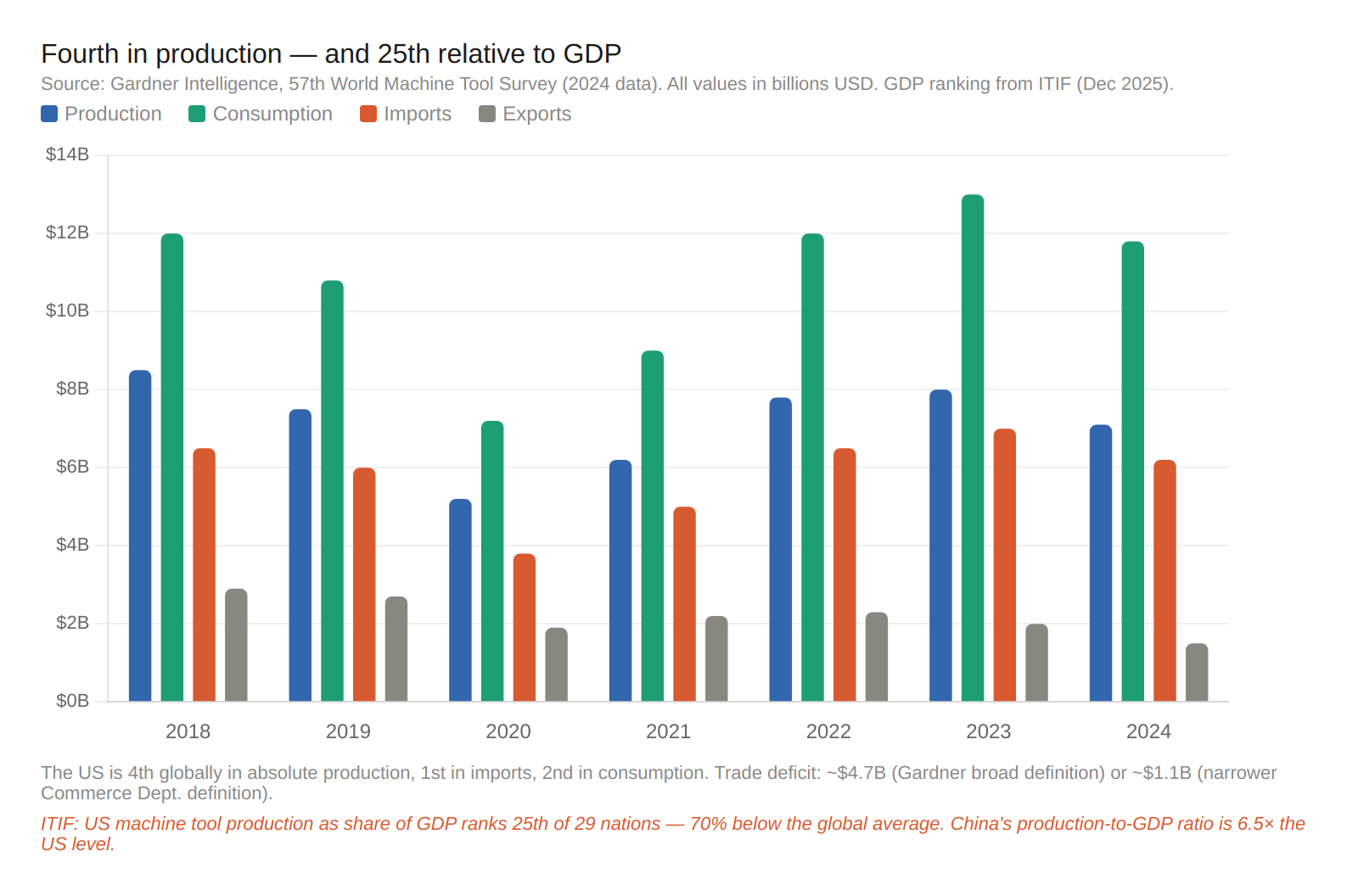
For precision grinding machines specifically, domestic production (roughly $1.1 billion) far exceeds imports (roughly $140 million). The U.S. still runs a trade deficit in grinding machines — exports are only about $41–46 million — and in machine tools overall the deficit is approximately $4.7 billion. But the domestic manufacturing base exists in a way that has no parallel in advanced semiconductors. American factories make grinding machines. They do not (yet) make leading-edge chips.
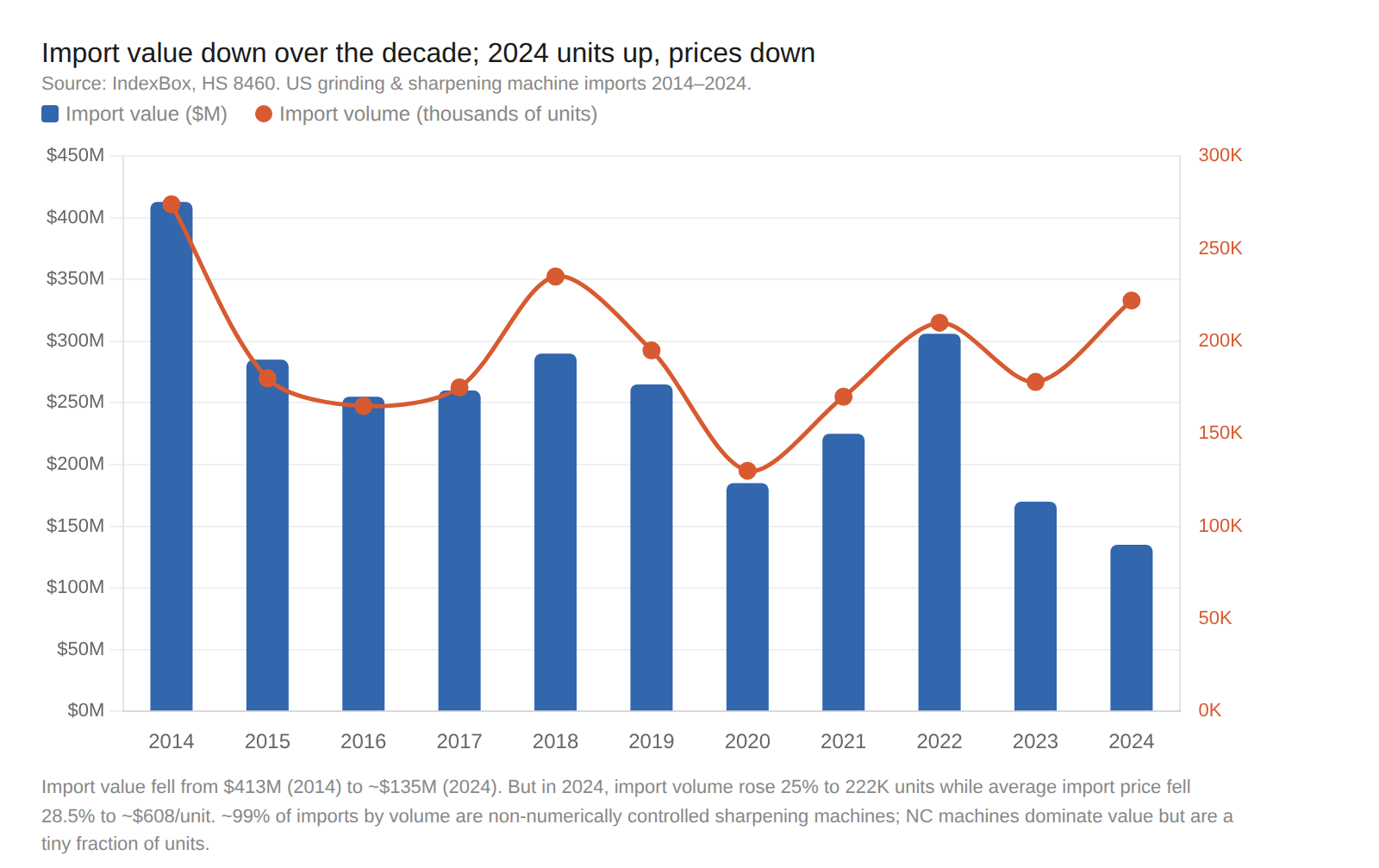
The import decline that alarms people — grinding machine imports fell from $413 million in 2014 to roughly $135 million in 2024 — needs to be parsed carefully. 2024 was a cyclical down year across machine tools, and longer-run structural factors include process substitution as additive manufacturing and hard turning replace grinding in some applications, and longer machine lifespans from IoT predictive maintenance. But the 2024 composition data does not point to a quality upgrade. Import volume actually rose — up 25 percent to 222,000 units — while average import price fell 28.5 percent to about $608 per unit. The decade-long decline in import value is real.3
Critically: China does not appear in the top three U.S. grinding machine suppliers by value or volume. Germany, Taiwan, and Japan lead by value; Sweden, Germany, and Japan lead by volume. China is a significant global exporter ($398 million in 2022), but those machines go to Russia, India, and Vietnam — not the United States. For grinding machines, the import story is about allied suppliers, not Chinese displacement.
I will come back to the limits of that finding.
The component everyone worries about
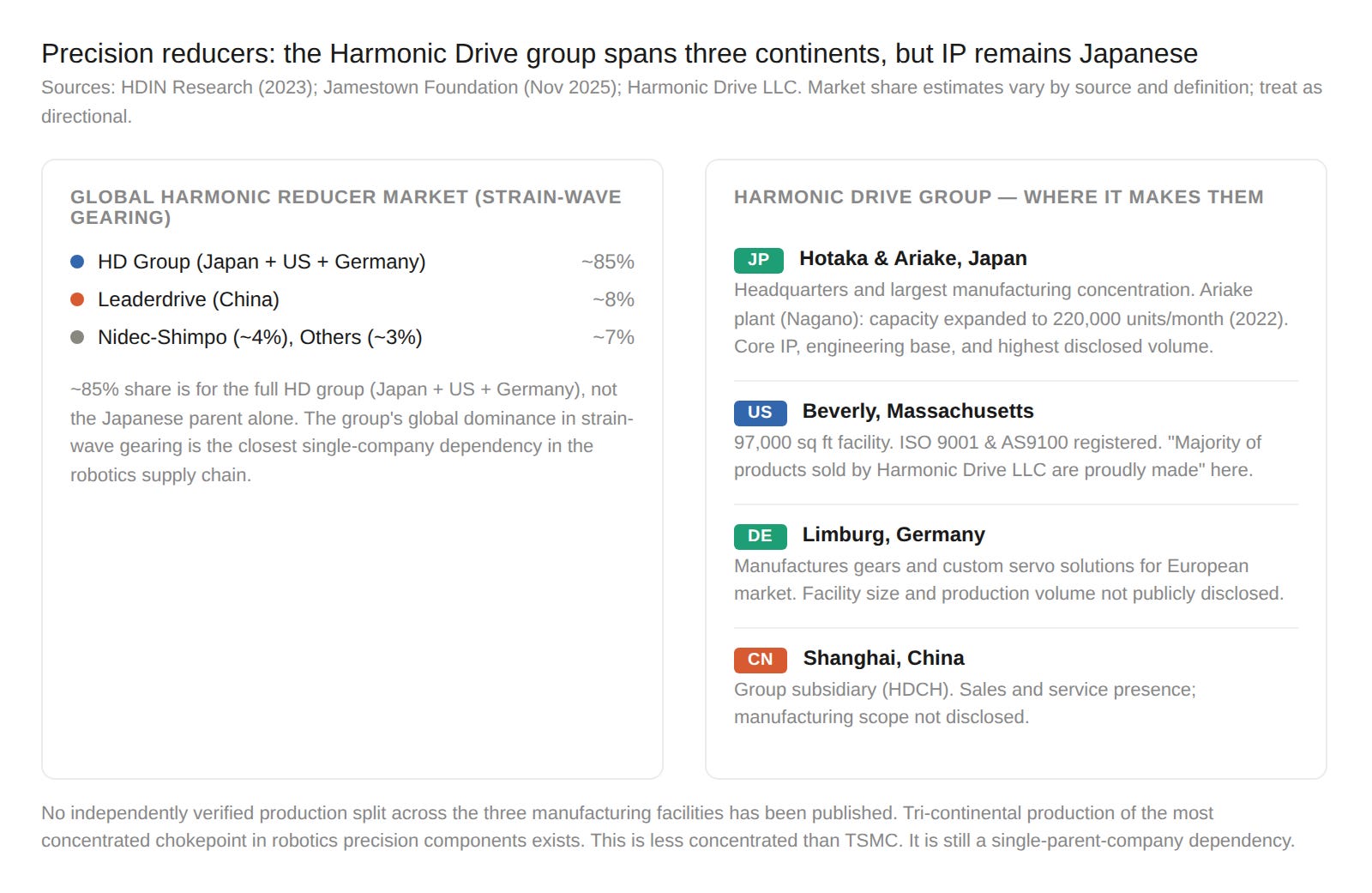
The component that concentrates minds most in robotics supply chain discussions is the harmonic drive — the strain-wave gear that gives robot joints their precision. The Harmonic Drive group holds roughly 85 percent of the global harmonic reducer market. That is the group — manufacturing in Japan (Hotaka, headquarters and largest facility), the United States (Beverly, Massachusetts — 97,000 square feet, ISO 9001 and AS9100 registered), and Germany (Limburg). The parent company’s intellectual property, core engineering base, and the largest disclosed production concentration remain Japanese. But tri-continental production of the most concentrated chokepoint in robotics precision components exists. This is less concentrated than TSMC. It is still a single-parent-company dependency.4
China's position is more dependent than Washington realizes — but rapidly improving
If the U.S. position is more nuanced than the semiconductor analogy implies, China’s position is more dependent than most people in Washington realize.
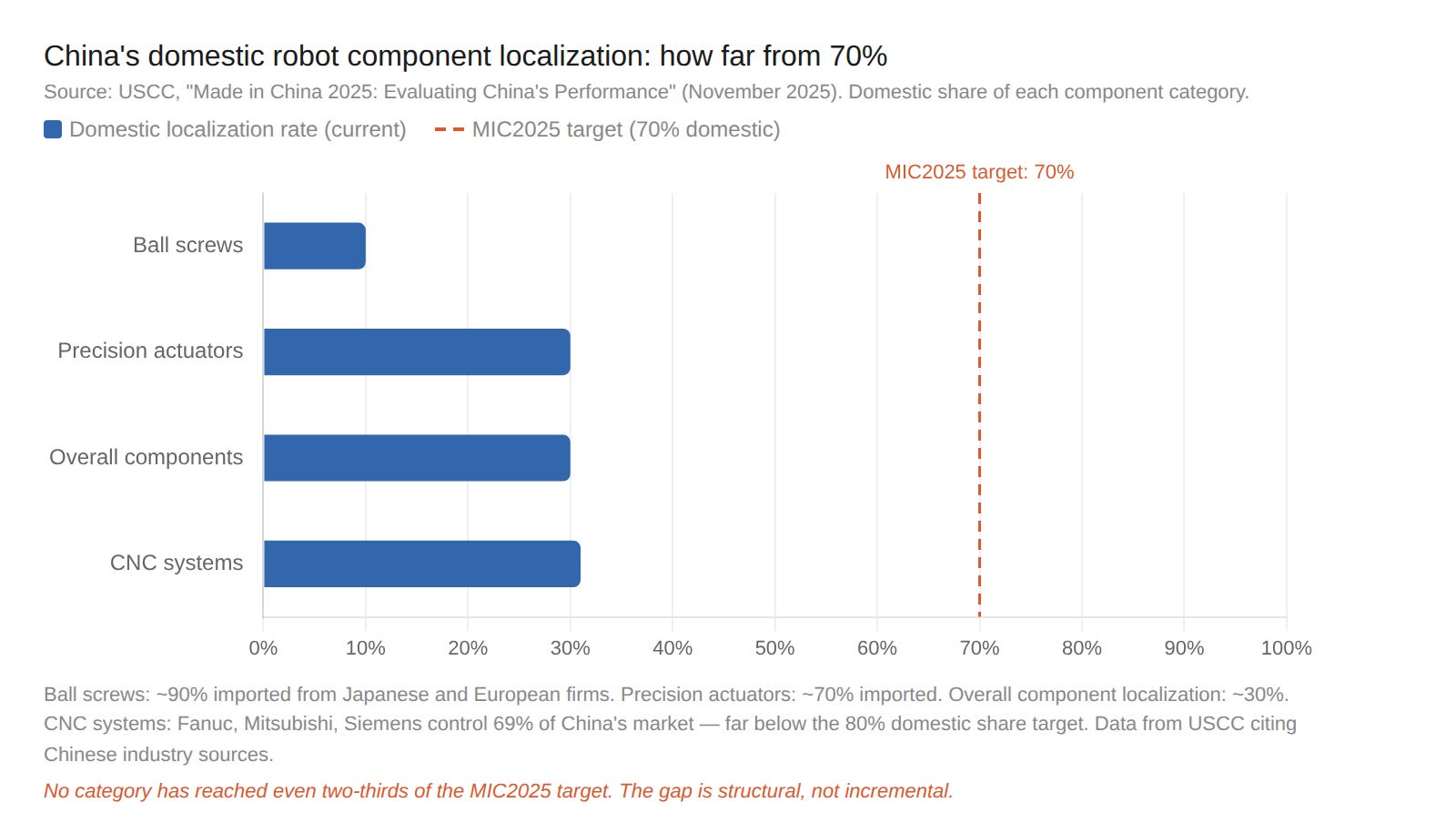
The U.S.-China Economic and Security Review Commission’s November 2025 assessment found that China’s robot component localization rate is roughly 30 percent. China imports approximately 70 percent of its precision actuators and approximately 90 percent of its ball screws — from Japanese and European suppliers. MIC2025 targeted 70 percent localization. They are not close. The USCC also notes that Japanese firms Fanuc and Mitsubishi and German firm Siemens still control 69 percent of China’s CNC market, far below the 80 percent domestic share China targeted.5
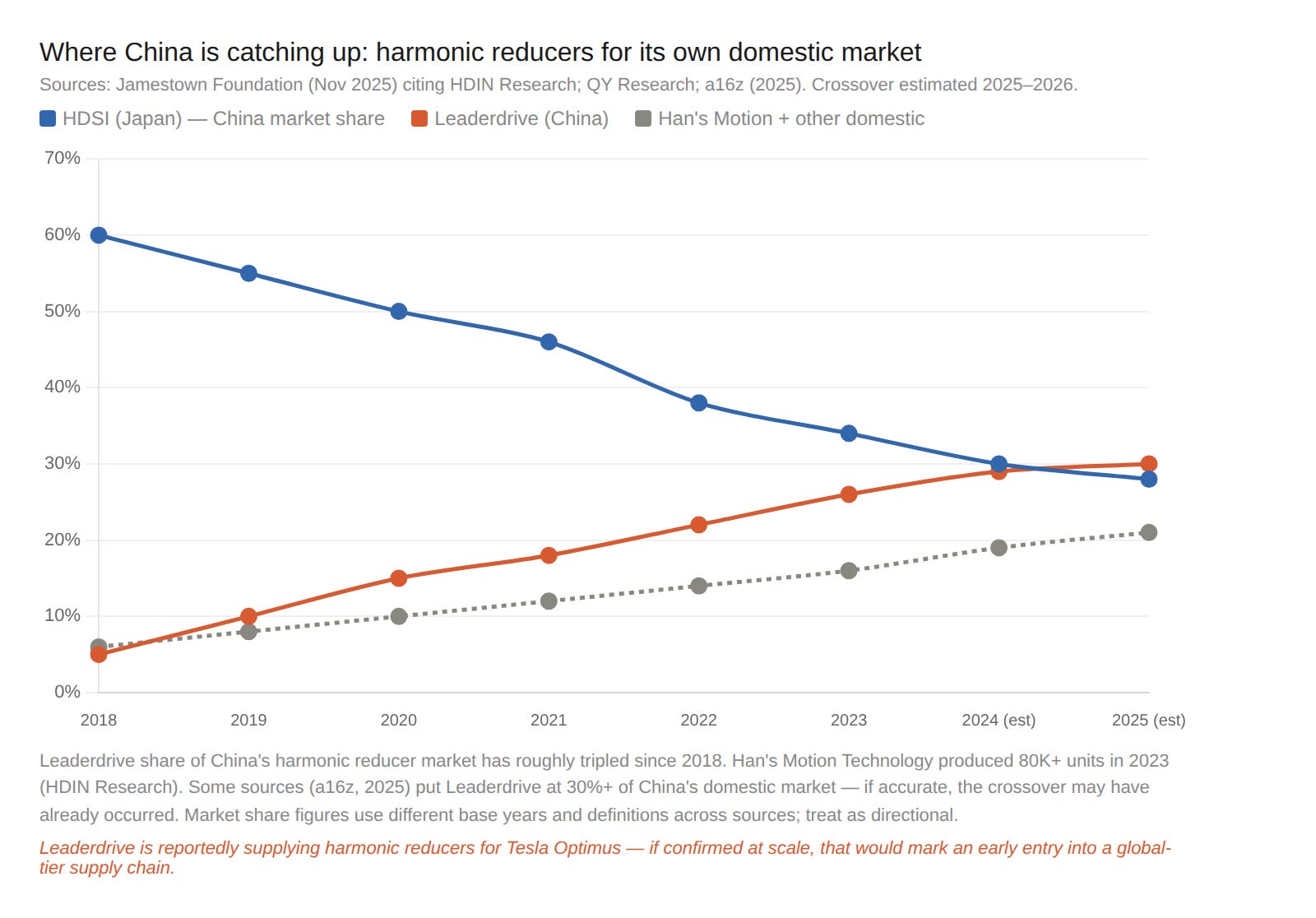
China is making progress where it matters most for its own domestic market. Leaderdrive’s share of China’s harmonic reducer market has roughly tripled since 2018 and, by some estimates, may have already crossed Harmonic Drive’s declining China share. Shenzhen Han’s Motion Technology is another emerging player, producing over 80,000 units in 2023. This matters for Chinese humanoid production costs and — as I will show — it is starting to matter for American ones too.6
The deployment paradox I described in the essay series has a supply chain dimension: the fastest path to self-sufficiency in robot components runs through massive deployment, which generates the demand that justifies the capital investment in domestic precision manufacturing. China is running this playbook. Whether it works fast enough to close the quality gap before allied leverage erodes is the central question — and it is not yet answered.
What the SEC filings show
Before turning to the humanoid supply chains — which is where the surprise was — it is worth seeing what the broader American industrial robotics sector looks like from inside the SEC filings. I pulled the 10-Ks for Intuitive Surgical, Symbotic, Teradyne (which owns Universal Robots), Rockwell Automation, Cognex, and Azenta. The pattern is consistent. Intuitive manufactures the “significant majority” of its surgical instruments in Mexicali, Mexico and the majority of its endoscopes in Germany. Symbotic uses third-party contract manufacturers and sources components from Germany, Italy, Sweden, Mexico, and China. Cognex's machine vision systems are manufactured by contractors in Indonesia and Malaysia, with optics from China and Vietnam — and the company explicitly flags Taiwan-sourced integrated circuit chips as an existential supply risk. Every 10-K acknowledges sole-source or single-source supplier dependencies. None of them name the specific suppliers or components. That opacity is itself a governance problem: policymakers cannot assess supply chain vulnerability when the companies themselves do not disclose where the chokepoints are.7
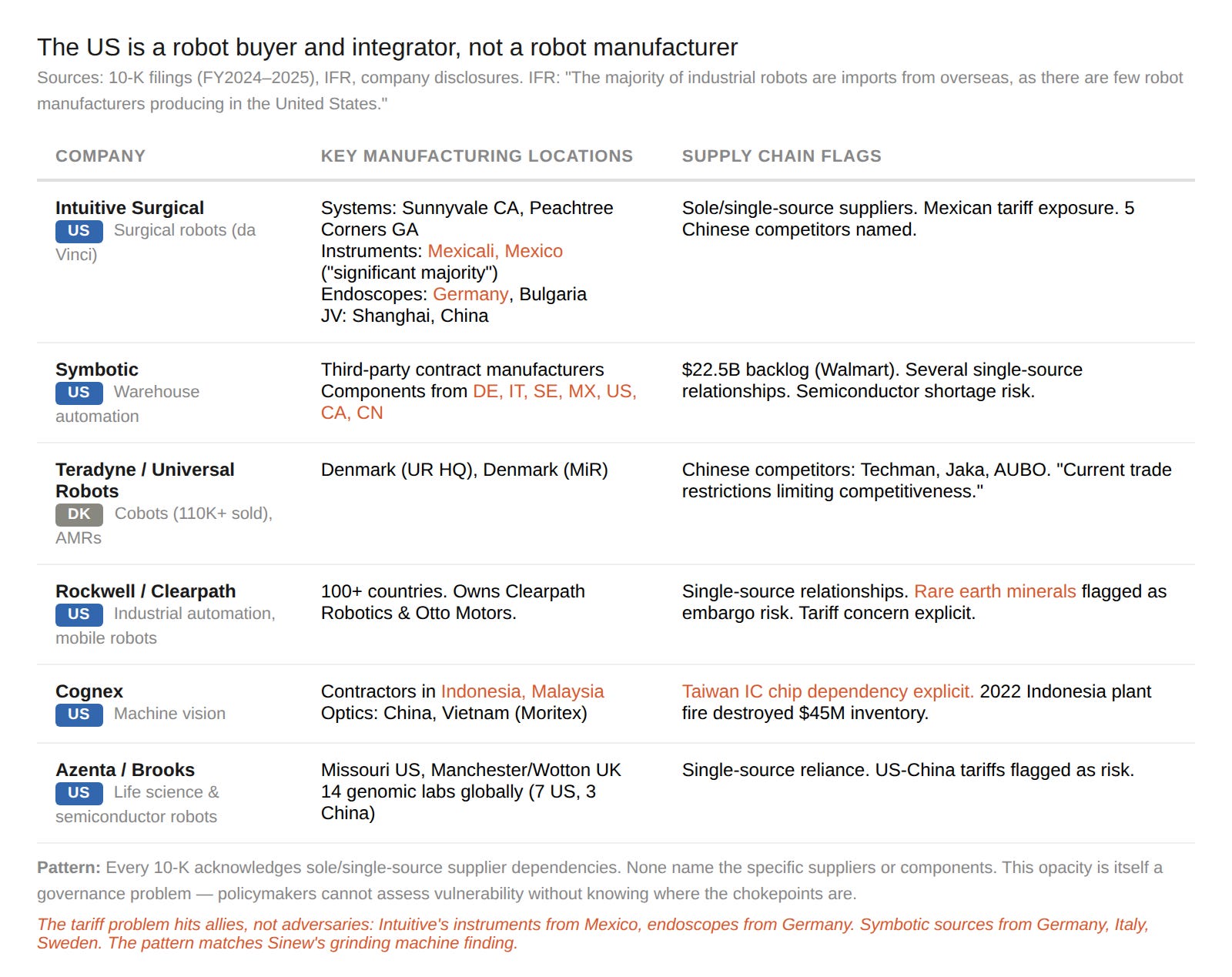
The SEC filings do not contradict the grinding-machine finding, but they support a narrower claim than “the whole industrial base.” Intuitive’s disclosed tariff exposure runs through Mexico and Germany. Symbotic’s component sourcing runs through Germany, Italy, Sweden, Mexico, the United States, Canada, and China. Cognex manufactures through contractors in Indonesia and Malaysia and explicitly flags Taiwan chip risk. Rockwell flags rare-earth and supplier-concentration risk — the one category where Chinese dependency is direct.
The pattern is real but not uniform: a mix of allied manufacturing exposure, North American assembly, and a few direct China-linked vulnerabilities: tariffs would primarily raise costs on allied imports.
The part I did not expect to find
On Tesla’s Q3 2025 earnings call, Musk said the humanoid supply chain is “non-existent” and it would force Tesla to “manufacture very deep into the supply chain.” This is the stated strategy. What follows is the emerging supply chain picture, as documented across multiple independent sources — the South China Morning Post, Goldman Sachs analyst channel checks, Thai government investment board approvals, and extensive Chinese financial reporting.8
Tesla’s Optimus actuator assemblies are reportedly being sourced from Chinese Tier 1 integrators. Sanhua Intelligent Controls appears to be supplying linear actuators (a reported $685 million order has been widely cited in Chinese financial media, though not independently confirmed by Tesla). Tuopu Group is providing rotary joint modules. Leaderdrive — the same Chinese firm catching up in the harmonic reducer chart — is reportedly supplying harmonic reducers. Xinjian Transmission is supplying planetary roller screws. In February 2026, five Chinese Optimus suppliers received Thai Board of Investment approval to build component factories in Thailand.
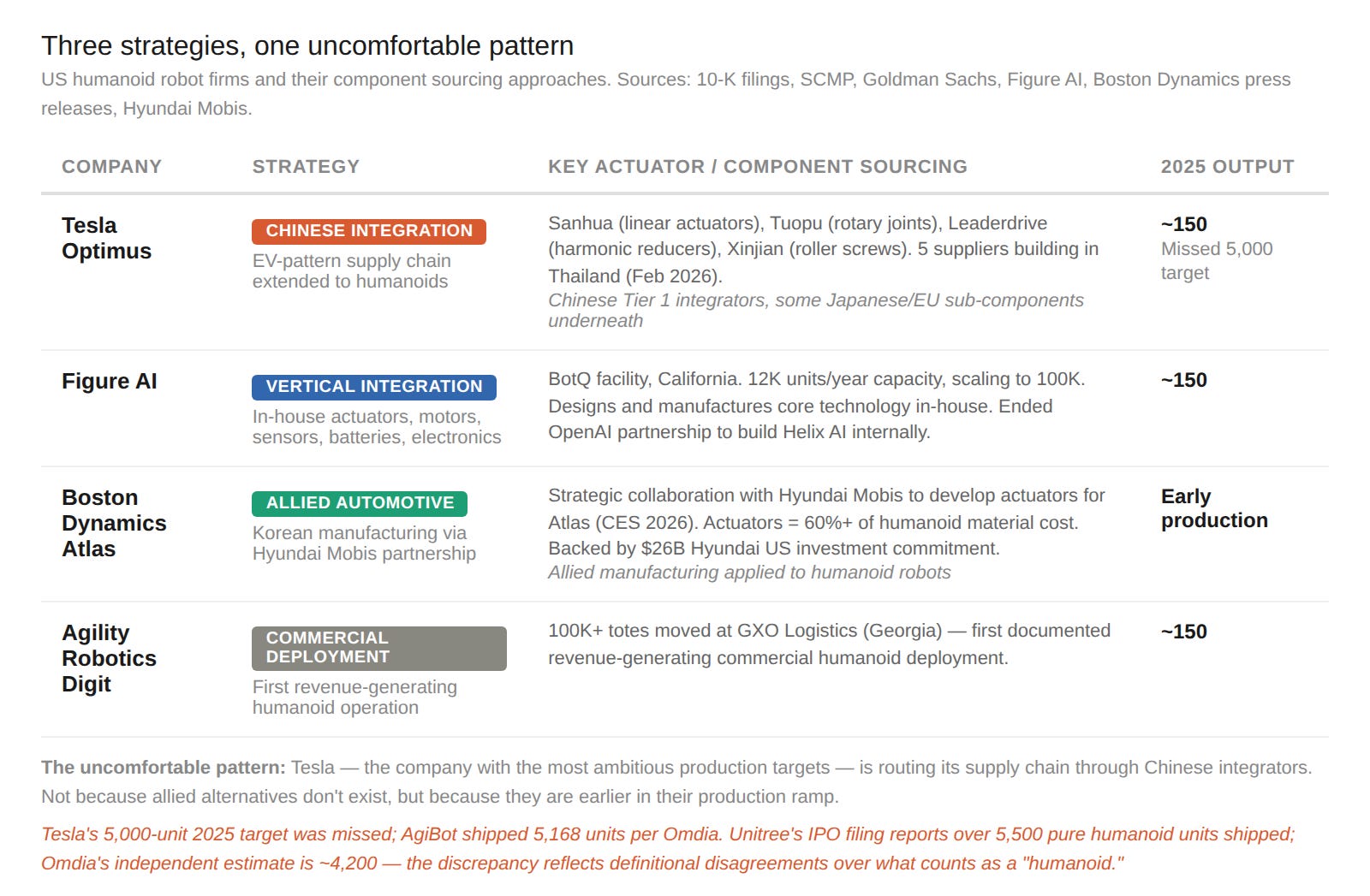
I want to be precise about what this is and is not. This is not “Tesla depends on China for everything.” Sanhua and Tuopu are integrators — they assemble actuator modules — and they themselves still source many precision sub-components from Japanese and European suppliers. The layers matter. What Tesla is building is an EV-pattern supply chain extended to humanoid robots: Chinese firms handle integration at the Tier 1 level, Japanese and European firms supply precision sub-components underneath, Tesla does final design and assembly in the United States. It is a layered dependency, not a binary one.
But this pattern complicates the narrative I set up in the essay series. The essay argued that bilateral chokepoints make robotics supply chains structurally different from semiconductors. They are. The U.S. and its allies do control critical precision components. And the company with the most ambitious production targets is choosing to route its supply chain through Chinese integrators anyway — because they are cheaper, faster, and already at scale — while the allied alternatives are still building.
Tesla targeted 5,000 Optimus units in 2025 and did not meet that goal. China’s leading humanoid firms outshipped U.S. peers by a wide margin: AgiBot delivered 5,168 units per Omdia, while Unitree’s pre-IPO filing reports over 5,500 pure humanoid units shipped in 2025 — though Omdia’s independent estimate is lower, at roughly 4,200, reflecting disagreements over what counts as a “humanoid.” The broader point holds at either number: Chinese firms were shipping at a scale U.S. firms were not, in part because they could draw on the same domestic supplier ecosystem that Tesla is now paying to access.
Figure AI and Boston Dynamics tell a different story. Figure designed almost its entire robot from scratch — actuators, motors, sensors, battery pack, electronics — and assembles core technology in-house at its BotQ facility in California, which has capacity for 12,000 units per year and is designed to scale to 100,000 over four years. Boston Dynamics announced at CES 2026 a strategic collaboration with Hyundai Mobis to develop actuators for Atlas — allied Korean manufacturing backed by Hyundai Motor Group’s $26 billion U.S. investment commitment. As Zack Jackowski, the Atlas general manager, put it, the collaboration gives Boston Dynamics access to “the well-established cost structures and scale potential of the automotive industry.”9
These are genuinely different strategies. Figure is betting on vertical integration, accepting higher near-term costs for control over quality and iteration speed. Boston Dynamics is leveraging allied automotive scale through its partnership with Hyundai Mobis. Tesla is leveraging Chinese manufacturing scale to hit ambitious production timelines. The industry does not have a single supply chain strategy. It has at least three.
What tariffs would actually do
For grinding machines, the finding is clear: the top U.S. suppliers are Germany, Taiwan, Japan, and Sweden. China’s roughly $7 million in grinding machine exports to the United States is a rounding error. Tariffs would primarily raise costs on allied imports. Robotics-specific trade data points in the same direction: NAM’s Section 232 submission, using Census trade data, reports that almost 65 percent of U.S. robotics imports come from Japan, Germany, and South Korea, with Mexico adding another 5.6 percent and China only 4.2 percent. That does not settle every subcategory in BIS’s scope, but it suggests the burden would fall heavily on allies here too.
But I need to be honest about the limits of that finding. BIS defined the investigation’s scope by product description, not by tariff code: CNC machining centers, lathes, milling machines, gear cutting machines, presses, EDM, robots, tool changers, and “parts and components.” I have verified supplier profiles for one product category within that scope — grinding machines. Whether the “tariffs hit allies, not China” pattern holds across CNC machining centers and lathes, I have not confirmed.
The precision components that actually determine humanoid robot supply chain dependency — harmonic drives, ball screws, actuators, gearboxes — are not explicitly named in BIS’s product descriptions. They could fall under the catch-all “parts and components” language, or they could fall outside the scope entirely. We do not know, and neither does the industry, which is part of the problem. The investigation may be examining the machines that make things while missing the components the robots are made of entirely — and even if it reached them, tariffs would be the wrong instrument. The ambiguity compounds the misdiagnosis.
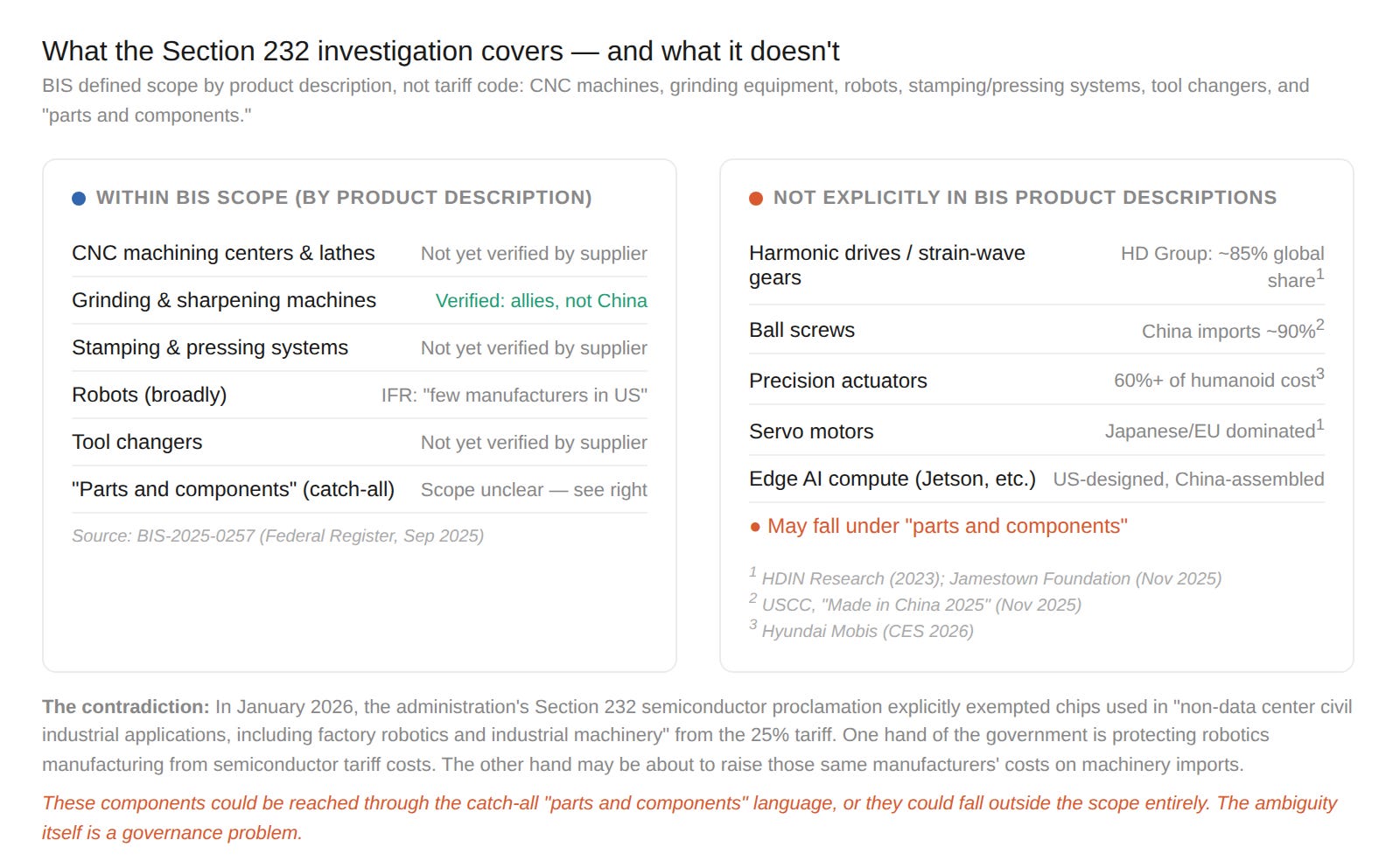
The National Association of Manufacturers argued in their October 2025 submission that tariffs would “significantly increase costs” on every U.S. factory floor. They are right — for grinding machines. And here is a revealing inconsistency: in January 2026, the administration’s Section 232 semiconductor proclamation explicitly exempted semiconductors used in “non-data center civil industrial applications, including factory robotics and industrial machinery” from the new 25 percent chip tariffs. One hand of the government is protecting robotics manufacturing from semiconductor tariff costs. The other hand may be about to raise those same manufacturers’ costs on machinery imports.10
For the leading U.S. firms, the more immediate problem may be manufacturing scale rather than foreign unavailability — though technology-access constraints for the highest-precision ball screws and certain reducer configurations have not been fully eliminated. Tariffs cannot solve a cost-competitiveness problem. Even if they could, Tesla’s Chinese suppliers are already building factories in Thailand. Trade barriers designed for a technology-access problem are irrelevant to a cost problem — and counterproductive when they raise costs for every American manufacturer trying to compete.
Why the cost gap exists
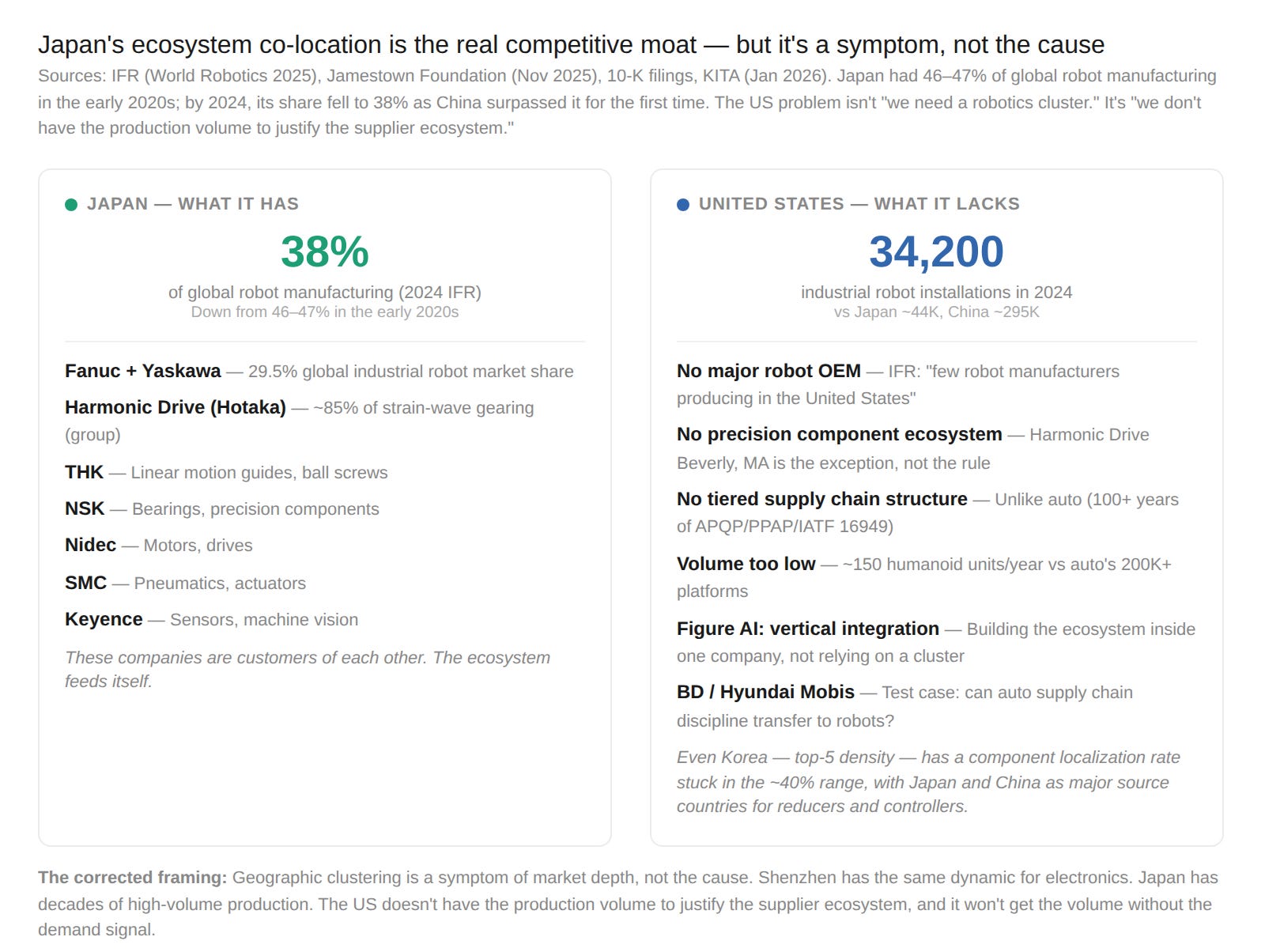
The chart tells the structural story. IFR put Japan’s share of global robot manufacturing at 46–47 percent in the early 2020s; by 2024, that share had fallen to 38 percent as Chinese manufacturers surpassed Japan for the first time. But the ecosystem depth remains. Fanuc, Yaskawa, Harmonic Drive, THK, NSK, Nidec, SMC, Keyence — these companies are customers of each other. The ecosystem feeds itself. The United States has no equivalent cluster, and the reason is not geography. It is volume. Japan’s supplier density is the symptom of decades of high-volume production, not the cause of it. Shenzhen has the same dynamic for electronics. South Korea is a useful warning case: despite world-leading robot density, its robot materials-and-components localization rate remains stuck in the 40 percent range, with Japan and China as major source countries for key inputs like reducers and controllers. Deployment does not equal supply-chain self-sufficiency. In 2024, the United States installed about 34,200 industrial robots; China installed 295,000. At 150 humanoid units per year, no American company can justify building the supplier ecosystem that Japanese firms built at automotive scale. The demand signal does not exist. That is the binding constraint — not access to components, but the production volume that would make domestic sourcing economically rational.
The semiconductor analogy is powerful because it is simple. The robot component picture is not simple. The United States has more domestic manufacturing capacity than the chip parallel suggests, meaningful allied sourcing, and genuine tri-continental production of critical precision components. These are real advantages.
And simultaneously, the company with the most aggressive production targets is building an EV-pattern supply chain through Chinese integrators — not because allied alternatives do not exist, but because they are not yet competitive on cost and scale. That is a different kind of dependency. It is not a chokepoint you can address with a tariff. It is a cost gap you can only close with investment.
Getting the topology wrong has consequences in both directions. Overstate the dependency and you reach for trade barriers that hit allies. Understate it — as I nearly did in an earlier draft of this analysis — and you miss the cost dynamics that are actually shaping where the supply chains go. The conventional wisdom is wrong. So is the easy correction. The binding constraint is not access to Japanese harmonic drives. It is that Chinese suppliers are cheaper, faster, and scaling.
I do not have a clean resolution. I have the data, and the data says the instruments do not match the problem. What instruments would match it — investment in domestic precision manufacturing capacity, workforce development in the trades that make these components, honest engagement with why cost gaps exist and what it takes to close them — I will return to in the essays that follow.
Section 232 investigation details from BIS docket BIS-2025-0257, Federal Register (September 26, 2025). Statutory deadline: 270 days from initiation. The copper 232 investigation completed in 144 days, suggesting the administration may move faster than the statutory timeline.
Machine tool production data from Gardner Intelligence’s 57th World Machine Tool Survey, reported via Modern Machine Shop. GDP-relative rankings from ITIF, “Mapping Industrial Strength: US Machine Tool Production and Consumption” (December 2025). The $4.7B trade deficit uses Gardner’s broad definition; a Commerce Department Section 232 filing found a $1.1B deficit using a narrower definition (exports $550M, imports $1.6B). Both figures are defensible under different scope definitions.
Grinding machine data from IndexBox, HS 8460. Import volume rose 25% to 222,000 units in 2024 while import value fell to ~$135M; the average import price fell 28.5% to ~$608/unit. About 99% of imports by volume are non-numerically controlled sharpening machines; higher-end NC machines dominate the value side but are a tiny fraction of units. The 2014-to-2024 decline in import value reflects structural factors operating over a decade; the 2024 year-over-year change reflects a cyclical contraction on top of those trends.
Harmonic Drive group market share of ~85% covers strain-wave gearing specifically, per HDIN Research. Estimates vary by source and market definition; the combined harmonic + RV reducer market uses different denominators. The Beverly, MA facility quote is from Harmonic Drive LLC’s website. HDSI’s Ariake plant (Nagano Prefecture) expanded capacity to 220,000 units/month in 2022; Hotaka is the group’s headquarters and original manufacturing site. No independently verified production split across the three facilities has been published.
China component localization data from the USCC’s November 2025 report. Imports come from “Japanese and European firms” — the USCC’s language, which I have preserved rather than narrowing to Japan alone. CNC market share data also from USCC.
Leaderdrive and Han’s Motion data from Jamestown Foundation (November 2025) citing HDIN Research and industry reports. Some sources (a16z, 2025) put Leaderdrive at 30%+ of China’s domestic market, which would place the crossover with HDSI as already having occurred. Market share figures use different base years and definitions across sources; treat as directional.
10-K filings: Intuitive Surgical (ISRG), FY ending Dec 31, 2025; Symbotic (SYM), FY ending Sep 27, 2025; Teradyne (TER), FY ending Dec 31, 2025; Cognex (CGNX), FY ending Dec 31, 2025; Rockwell Automation (ROK), FY ending Sep 30, 2025; Azenta (AZTA), FY ending Sep 30, 2025. All sourcing descriptions are quoted or closely paraphrased from the companies’ own risk factor disclosures and manufacturing descriptions. The “significant majority” language for Intuitive’s Mexican manufacturing is the company’s phrasing. Cognex Taiwan IC chip risk is verbatim from the 10-K: “An escalation of the China-Taiwan conflict could also lead to challenges procuring integrated circuit chips from Taiwan-based vendors.”
Tesla supply chain sources: South China Morning Post (February 2026) reported Tesla has engaged “hundreds of Chinese parts suppliers” over three years. Goldman Sachs analyst Jacqueline Du published channel checks with Chinese humanoid supply chain companies including Sanhua, Tuopu, and Shuanghuan. Five suppliers (Sanhua, Tuopu, Xinjian Transmission, Bete Technology, Xusheng Group) received Thai Board of Investment approval (February 2026) to build factories for Tesla robot components. The $685M Sanhua order figure originates in Chinese financial media (36kr) and has not been independently confirmed. The “70% of BOM” estimate appears in Chinese securities research with A-share hype incentives; I have not used it in the text. Tesla’s missed 2025 production target confirmed by Rest of World (March 2026). AgiBot shipped 5,168 units per Omdia; Unitree claims 5,500 units shipped (pre-IPO filing; Omdia puts Unitree at ~4,200 — the discrepancy reflects definitional disagreements over what counts as a “humanoid”). Counterpoint Research (January 2026) estimates 16,000 total humanoid installations globally in 2025, with China accounting for over 80 percent.
Figure AI: BotQ launched March 2025. 12,000 units/year initial capacity; designed to scale to 100,000 robots / 3 million actuators over four years. Figure designs actuators, motors, sensors, battery packs, and electronics in-house; ended its OpenAI partnership in February 2025 to build AI (Helix) entirely in-house. Boston Dynamics: Hyundai Mobis collaboration announced at CES 2026 (January 7). Jackowski quote from Boston Dynamics press release. Actuators represent over 60% of humanoid robot material cost per Hyundai Mobis.
NAM submission (October 2025), Section 232 docket. Robotics import shares calculated from DataWeb/Census data accessed June 30, 2025, with household appliances subtracted from the HS machinery category. Section 232 semiconductor proclamation: Presidential Proclamation 11002 (January 14, 2026) exempted semiconductors used in “non-data center civil industrial applications, including factory robotics and industrial machinery” from the Semiconductor 232 tariffs.
great piece, may I know where I can check this number "South Korea is a useful warning case: despite world-leading robot density, its robot materials-and-components localization rate remains stuck in the 40 percent range, with Japan and China as major source countries for key inputs like reducers and controllers"? want to compare with china and US